
Last modified: 2026-11-14 by  klaus-michael schneider
Keywords: regiments(denmark) | regimental colour |
Links: FOTW homepage |
search |
disclaimer and copyright |
write us |
mirrors
 mage by Klaus-Michael Schneider
Currently we know only about five flags with two of them without knowing the unit.
Klaus-Michael Schneider, 9 Oct 2025
 image by Klaus-Michael Schneider, 9 Oct 2025
The flag is dark red semy of little flames Or of different shape. The central charge is Nike,the Goddess of victory, naked with a bow and a sword flamant,
both Argent, and a quiver with three arrows with white feathers. She stands on a blue globe winged Or. On base is a golden number "1627". On upper fly is the golden cypher "C4" of the king.
The standard has silver and dark red fringes at three edges.
Source: Crampton 1990, p.40
Klaus-Michael Schneider, 9 Oct 2025
 image by Klaus-Michael Schneider, 9 Oct 2025
The ratio is approximately 3:5. The flag is white with a Dannebrog in canton.
The central charge is a white armed arm coming out of clouds of greyish blue, holding four grey thunderbolts and two flames proper. Beneath is an inscription in red initials "TERROR IN HOSTES"
(= (put) fear into the enemies).
Source: Crampton 1990, p.40
Klaus-Michael Schneider, 9 Oct 2025
 image by Klaus-Michael Schneider, 29 Oct 2025
The colour was green with 19 golden (yellow) grenades flamant in orle. In canton is a Danebrog in counterchanged colours, i.e. a white square parted by a red centred cross.
On centre in an oval golden wreath is a silver arm clad in armour, coming out from a cloud of the same.
The arm holds a silver sword in pale decorated by two golden branches of laurel.
In the top of the wreath is a golden embowed inscription "CUI VULT".
Above from the wreath is a golden inscription: "DOMINUS PROVIDEBIT" and below another golden inscription:
"GUTE BEDACHTSAMBKEIT MÄNNLICHE TAPFERKEIT" (1st line) "GEHÖREN BEIDE ZUM STREIT" (2nd line). The inscription below is in German.
The translation of all is: "The Lord will provide to whom he wills" and "Good thoughtfulness male bravery" (1st line) "Both are part of the fight" (2nd line).
The colour was used by the crown prince, later King Frederik 3 of Denmark, and then being Archbishop of Bremen and Bishop of Verden.
The colour was used somewhere between 1635 and 1645. The width of the colour had been 266cm. An arm clad in armour had been a typical motive of Protestant flags and standards.
The counterchanged tinctures of the canton are probably belonging to a younger prince of the royal family of Denmark.
Source: Wise and Rosignoli 1978, plate 3, row 3, column 2 ,p.93
Klaus-Michael Schneider, 29 Oct 2025
 image by Klaus-Michael Schneider, 29 Oct 2025
The standard is horizontally parted of silver and gold which rich damascene embroideries.
In centre is a red disc charged with a crowned golden lion rampant holding a silver embowed halberd by his forepaws. The disc is surrounded by a golden circle laurel leaves interrupted by four red heraldic roses seeded golden.
The canton is red parted by a white cross patty. The standard has golden and silver fringes.
Though made for the Jutland Cavalry in Viborg in 1648 the central motive is the lion of Norway.
According to source it was common practice until 1664 to use parts of the Greater Arms of Denmark. Terence Wise displays the wreath as green,
but Williaam Crampton displays it as golden and the sheet with floral damascene ornaments and says it belongs to a Norwegian Regiment.
Norway had been united with Denmark until 1814. According to Terence Wise the width of the standard had been 65cm and the height 54cm.
Sources: Wise and Rosignoli 1978, plate 3, row 3, column 1, pp.92-93 and Crampton 1990, p.42
Klaus-Michael Schneider, 29 Oct 2025
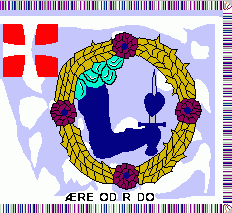 image by Klaus-Michael Schneider, 12 Nov 2026
The ratio is approximately 10:9. The standard is made of white silk. But wide parts of the sheet nowadays have been destroyed (painted in light violet colour by me).
The image on the centre is a dark blue bended arm clad in armour, coming out from blueish green clouds. It was surrounded by a golden wreath of laurel parted by four dark red roses seeded blue.
The arm holds a dagger piercing a dark blue heart. In canton is a Dannebrog. At bottom is a black inscription "ÆRE OD(E)R DO(DT)" (= honour or death).
The whole is surrounded by silver fringes except the hoist side.
The company probably was commanded by Jørgen Skeel (1578 - 1631).
In 1609 he became a lieutenant in the Aarhus Company (Danish: Aarhusfanen / German: Aarhus Fähnlein), also called the "White Company" (Danish: den hvide fane) of the Jylland Rostjeneste, a cavalry service of noblemen, somehow like the British Yeomanry.
Skeel served with distinction in the Kalmar War (1611 – 1613) and attained the rank of a captain of cavalry (Danish: Ritmester).
In 1616 he was appointed a Knight of the Order of the Armed Arm (Danish: Væbnede Arms Orden), which had been established the same year by King Christian 4 for those, who had excelled during the Kalmar War.
The symbol of the arm on standard provided the name of that chivalric order.
Sources: Danish WIKIPEDIA and own photo made on 21 August 2026 in Krigsmuseet København
Klaus-Michael Schneider, 12 Nov 2026
back to Danish Regimental Colours and Standards click here